

Mayan Elephants
On tourism and the quest for authenticity

As a pastor and a white tourist, I am professionally trained to look for things that aren’t there. In my day job, I’m often chasing the “purity” of the early church; on vacation, I’m the guy in the floppy hat scouring the Andes for a “traditional” experience that hasn’t been “tainted” by the 21st century. I am, in other words, a walking, breathing, slightly sunburnt embodiment of the authenticity police.
I recently had a moment of profound, self-inflicted irritation in Mexico that perfectly illustrates my condition. I was at Chichen Itza, visiting a store run by indigenous Mayans. I was prepared to be dazzled by ancient symbols and jaguars carved from obsidian. Instead, I found myself staring at a shelf of wooden elephants.
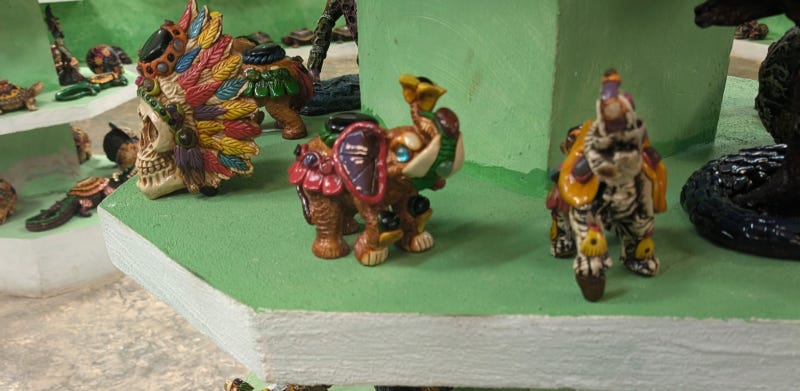
Now, I’m no biologist, but I was fairly certain that elephants aren’t indigenous to the Yucatán. I felt that familiar itch of the “awkward tourist” who feels he’s being sold a “pseudo-event”. I asked the clerk why on earth they were making elephants. He looked at me with the patience one reserves for a particularly slow child and said,
“A lot of tourists ask for elephants. And we really like elephants. So we made some!”
My internal Authenticity Meter hit red. This isn’t authentically Mayan! I fumed. But then, as the sweat dripped off my nose, a realization hit me: these were made by Mayan people, in a Mayan style, because they wanted to make them. What could possibly be more authentic than a living person creating something they actually like?
Real Christians Don’t Read the New Testament
I see this same “quest for the pure” back home in the pews. Many people of faith harbor a deep, misty-eyed desire to return to the “New Testament Church.” We imagine a “Golden Age” where everyone was in perfect accord, the liturgy was pure, and the potlucks were miraculously low-carb.
But modern scholarship suggests that this Golden Age is a mirage. The early Christian movement didn’t start as a unified, coherent organization. It was an “explosive spread” of diverse, regional “brands” of Christianity that were often in direct competition. In Rome, you had Justin Martyr’s school down the street from the gnostic teacher Valentinus and the “heretic” Marcion, all while the “official” tradition was trying to find its feet. They were “squabbling” from the very beginning about how Jewish or Greek they should be, and whether the death of Jesus or his secret sayings were the real point.
The Book of Acts gives us a “simplified” picture of smooth, spirit-led growth, but the historical reality was a riot of diversity. The “New Testament Church” isn’t a historical reality we can return to; it’s a social construction we’ve built to satisfy our own modern anxieties.
Perhaps the funniest part of our “New Testament Church” obsession is our attachment to the Bible itself. We walk into service with our leather-bound English translations as if the Apostles were handing them out at the door in Jerusalem.
In reality, the Bible as a unified “canon” didn’t even exist until the end of the 4th century. For the first few hundred years, “church” was a collection of house assemblies reading whatever letters or oral traditions they could get their hands on. When the Bible finally did get stitched together, it wasn’t in English; it was in Greek and Latin.
We love the idea of “Bible-based” authenticity, yet the very act of a layperson owning and reading a personal copy in their own language is a “post-New Testament” development. We’ve collectively decided that having Bibles in pews is “authentic,” simply because we like the idea of it. Just like the Mayan elephants, we’ve created a tradition because it fits our current needs, then labeled it “ancient” to give it weight.
Real Gatekeeping
Here is the darker side of our obsession with the “pure” and “untouched.” Authenticity isn’t just a marketing buzzword; it’s a gatekeeping method used by those in power to control and exploit.
